On the disappearance of a Hollywood institution, the beauty of tungsten lighting, and the gradual loss of the physical craft of filmmaking.
THE BACKSTORY
I remember my first experience with proper studio lighting at Ball State University. At the time, our studios were filled with Mole-Richardson fixtures, those enormous maroon lights that had been a staple of Hollywood for decades. They were big, they were heavy, and they were hot. I mean, really hot. Anyone who has worked with tungsten fixtures knows exactly what I'm talking about. If you've never had the pleasure, imagine taking a couple thousand watts of electricity, running it through a filament, and then standing a few feet away from it for several hours. It doesn't take long to understand why film sets used to get so incredibly warm. Still, there was something wonderful about those lights. They were solid, beautifully constructed, and seemed to be capable of taking just about anything you threw at them. They were also remarkably simple, at least compared to the computerized fixtures we use today. You had a bulb, a reflector, a lens, and a few mechanical controls. That's about it. Of course, I didn't appreciate any of this at the time. They were simply the lights we had, and like any student learning a craft, I was far more concerned with getting a good image than understanding the history of the equipment that made it possible.
One thing I did learn rather quickly was to wear gloves. Now I don't mean the sort of gloves you might wear to keep your hands warm in the winter. I'm talking about proper leather work gloves, the kind that would allow you to adjust a barn door or move a fixture without immediately regretting your decision. Even after switching a light off, it could remain painfully hot for quite some time. Touch the wrong part of a fixture and you'd know it. I learned to be careful around hot lamps, to pay attention to where cables were running, and to think about how much electricity we were pulling from a circuit. There was a certain amount of respect that these lights demanded, and if you didn't give it to them, they'd quickly remind you why you should. My wife had her own experiences with Mole-Richardson, using their softer lighting fixtures for photography. While I was learning to shape the focused beams of their Fresnels, she was using the company's softlights to create the kind of beautiful, even illumination that portrait photographers have relied on for generations. Between the two of us, Mole-Richardson had played a considerable role in our creative education, although neither of us really gave the company much thought beyond that.
As time went on, however, I began to move away from tungsten lighting almost entirely. Like many filmmakers of my generation, I bought fully into the LED revolution, and frankly, I don't regret it. The benefits were simply too substantial to ignore. Suddenly we could produce a tremendous amount of light without generating nearly as much heat, and we could do it while consuming a fraction of the electricity. We could adjust brightness without dramatically changing color temperature, dial in different white balances without having to gel fixtures, and eventually create just about any color imaginable with the turn of a knob. For someone who frequently films in old churches, historical buildings, and other locations that were never designed to accommodate a motion picture crew, this was a tremendous advantage. A single 2K Mole draws nearly 17 amps on a 120-volt circuit. Plug that into the wrong outlet in a hundred-year-old building, and you might find yourself explaining to a rather unhappy priest why the lights in half his church suddenly went out. With LEDs, we could often light an entire interview using less electricity than one of those old tungsten fixtures required. Better yet, many could be powered by batteries, which meant we didn't even need to find an outlet. It was easier, faster, cooler, and in many situations considerably safer. What's not to love?
At work, we eventually picked up a handful of Mole-Richardson fixtures, although not necessarily because we needed them. We had a massive 2K, along with a few smaller 1K lights, and for the most part, we purchased them because they looked fantastic. There's something about a big maroon Mole sitting in the background of an interview that immediately says cinema. We had the electrical infrastructure to run them properly, but most of the time we simply dimmed them down and used them as background elements. Occasionally we'd let one stretch its legs, and I'd be reminded just how much light those things could produce, but those occasions were few and far between. They were props more than anything else. Beautiful props, certainly, but props nonetheless. I appreciated them in much the same way I appreciate any historical element of filmmaking, whether that's an old Mitchell camera, a vintage Cooke lens, or a beautifully machined piece of grip equipment. I liked the history, I liked the craftsmanship, and I liked the way they looked. But I can't honestly say I fully appreciated them for what they were.
That changed when I learned that Mole-Richardson had closed its doors. I'll admit, I was surprised. I knew tungsten lighting had largely fallen out of favor, and I knew the company wasn't nearly as prominent in the LED world as manufacturers like ARRI, Aputure, or Litepanels, but Mole-Richardson was one of those names that I simply assumed would always be around. Like Kodak, Panavision, or Zeiss, the company seemed so thoroughly woven into the history of filmmaking that the idea of it disappearing was almost difficult to comprehend. Yet here we were, nearly a century after its founding, watching one of Hollywood's most important equipment manufacturers sell off its remaining inventory and close its doors. I began reading more about the company, looking through old catalogs, researching its fixtures, and eventually purchasing a few for my own collection. The more I learned, the more fascinated I became. And the more fascinated I became, the more disappointed I was that I hadn't paid closer attention while the company was still around.

Mole lights on the set of “Birds”.
THE HISTORY
To understand Mole-Richardson, we need to go back to Hollywood in the 1920s, a time when the motion picture industry was undergoing some rather extraordinary changes. Silent films were still the standard, sound pictures were just around the corner, and the studios were rapidly developing the technical infrastructure that would eventually make Hollywood the center of the filmmaking world. Lighting was a particularly interesting challenge. Early filmmakers relied heavily on natural sunlight and carbon-arc lamps, which could produce tremendous amounts of illumination but weren't particularly convenient to operate. Carbon arcs required constant attention, generated considerable heat, and were hardly ideal for the increasingly complicated productions being developed by the major studios. The industry needed something better, and a young electrical engineer named Peter Mole recognized the opportunity.
Mole was born Pietro Mule in Sicily in 1891 and immigrated to the United States with his family as a child. He eventually studied electrical engineering and worked for General Electric before moving to Los Angeles in 1923. Now I think it's worth remembering that electrical lighting itself was still a relatively young technology at this point. The incandescent light bulb had only become commercially practical a few decades earlier, and engineers were still discovering new ways to use electric illumination. Motion pictures presented a particularly interesting challenge because filmmakers needed enormous amounts of light, but they also needed to control that light with a degree of precision that ordinary industrial lighting simply wasn't designed to provide. In 1927, Mole joined forces with Elmer C. Richardson and established a small company in Hollywood that would eventually bear both of their names. Like so many great American manufacturing stories, it began in a garage.
The timing couldn't have been better. With the introduction of synchronized sound, filmmakers suddenly needed lighting instruments that were quieter and more practical than the carbon-arc fixtures that had dominated earlier productions. Tungsten incandescent lighting offered a compelling alternative, and Mole-Richardson quickly began developing fixtures specifically designed for motion picture use. By 1928, just a year after the company's founding, the Academy of Motion Picture Arts and Sciences and the American Society of Cinematographers were already working with Mole-Richardson on the technical development of incandescent studio lighting. That's a rather impressive accomplishment for a company that had barely gotten off the ground. Still, the invention that would truly establish Mole-Richardson as a Hollywood institution was yet to come, and interestingly enough, the optical principle behind it was already more than a century old.
In 1935, Mole-Richardson introduced its Fresnel Solar Spot, a fixture that would help define the way motion pictures were lit for generations. The Fresnel lens itself was originally developed by French physicist Augustin-Jean Fresnel in the nineteenth century, primarily for use in lighthouses. Rather than producing an enormous, thick piece of glass to focus light, Fresnel designed a lens using concentric rings that could accomplish much the same thing with substantially less material. It was a brilliant design, and one that proved particularly useful when you needed to focus large amounts of light without building an absurdly heavy optical assembly. Mole-Richardson adapted this principle to motion picture lighting, creating a fixture that could produce a powerful, relatively even beam while allowing the operator to adjust its spread from spot to flood. For cinematographers, this was an enormous advancement. Suddenly they had a compact, controllable instrument that could be used to illuminate an entire set or produce a focused beam of light on a particular subject. The Academy eventually recognized Mole-Richardson's technical contributions with multiple awards, and the Fresnel became one of the most recognizable lighting instruments in the history of cinema.

Now for those unfamiliar with Fresnel lighting, the appeal isn't simply that the fixtures produce a lot of light. A bare incandescent lamp can do that, and so can any number of open-face fixtures. What makes a Fresnel special is the ability to control that light. By moving the lamp and reflector assembly relative to the lens, the operator can adjust the beam from a relatively narrow spot to a considerably wider flood. The light itself has a characteristic quality, with a controllable center and a relatively smooth transition toward the edges. Add a set of barn doors, a few scrims, and perhaps a flag or two, and you have an incredibly versatile instrument. You can create a hard shaft of sunlight, a dramatic rim light, or a relatively broad source that can be bounced or diffused as needed. It's an elegantly simple design, and one that remains useful today. In fact, many modern LED manufacturers still produce Fresnel fixtures or Fresnel attachments based on precisely the same optical principle. Nearly a century later, the concept remains remarkably difficult to improve upon.
With the success of the Solar Spot, Mole-Richardson quickly became one of Hollywood's premier lighting manufacturers. Its distinctive maroon fixtures began appearing on soundstages throughout California, and over the following decades the company developed an enormous catalog of equipment. There were tiny Inkies, little fixtures designed to fit into places where larger lights simply wouldn't work. There were Baby Fresnels, Tweenies, Juniors, Seniors, Teners, and a host of other instruments that became standard equipment for generations of cinematographers. Some were relatively small, producing a few hundred watts of illumination, while others were absolutely enormous. The company's 10K and 20K Fresnels were particularly impressive, with the latter consuming twenty thousand watts of electricity. To put that into perspective, a 20K fixture draws roughly 83 amps at 240 volts, which is considerably more than an ordinary household circuit can provide. These weren't lights you casually tossed into the back of a car. They required substantial stands, proper electrical distribution, and crews who understood exactly what they were doing. But if you needed to illuminate an enormous set or create a powerful beam of artificial sunlight, these were the tools for the job.
Mole-Richardson also manufactured a wide variety of other lighting instruments, including broad lights, softlights, open-face quartz fixtures, Mole-Beams, and massive multi-lamp arrays like the Maxi-Brute. Some of these were particularly interesting because they were designed around very specific lighting problems. A Mole-Beam, for example, uses a parabolic reflector to produce an extremely concentrated beam, making it useful when you need to project light over considerable distances. The Maxi-Brutes, meanwhile, combined multiple high-output lamps into a single assembly, producing enormous amounts of illumination for large sets or exterior work. There were also fixtures designed specifically for television studios, portrait photography, and other applications that required something different from the traditional Hollywood Fresnel. And while we tend to associate Mole-Richardson with tungsten lighting, the company eventually produced HMI daylight fixtures and an extensive lineup of LEDs as well. For much of the twentieth century, if you needed a particular type of motion picture light, there was a good chance Mole-Richardson made something for the job.

The company also found work outside the motion picture industry. During World War II, Mole-Richardson applied its optical and electrical expertise to military lighting equipment, including searchlights. In 1945, Peter Mole was invited to provide lighting for the first United Nations conference in San Francisco, a rather interesting assignment for a company primarily associated with Hollywood. By that point, Mole-Richardson had expanded considerably from its humble beginnings, and its products were being used far beyond California. The company established a British manufacturing operation in the 1930s, and its equipment eventually became familiar to cinematographers around the world. What I find particularly interesting, however, is that despite this growth, Mole-Richardson remained closely tied to the family of its founder. When Peter Mole died in 1960, leadership passed to his son-in-law, Warren Parker, and eventually to Parker's son Michael. While so many other American manufacturers were purchased, consolidated, or absorbed into larger corporations, Mole-Richardson remained a family-controlled company for nearly its entire existence.
And then there's the construction. Oh, the construction. If you've ever handled an older Mole-Richardson fixture, you'll understand why these things have such a following among collectors. They're built like tanks, and I don't mean that in the way people describe a modern plastic camera that happens to survive being dropped once or twice. I mean they're genuinely substantial pieces of industrial equipment. Heavy metal housings, thick glass lenses, robust yokes, replaceable sockets, mechanical focusing systems, and hardware that seems almost absurdly overbuilt by modern standards. Some of the older fixtures even have beautiful brass components, often hidden beneath decades of paint. There's a wonderful simplicity to them as well. You don't have circuit boards, touchscreens, proprietary software, or wireless receivers. You have a lamp, a reflector, a lens, and a mechanical assembly that holds everything together. If something breaks, there's a reasonable chance you can repair it. And because these fixtures were designed to be serviced, many have remained operational for fifty, sixty, or even seventy years. Imagine buying a modern electronic light and expecting it to work in 2090. I certainly wouldn't count on it.
This build quality is one of the reasons Mole-Richardson endured for so long. For decades, professional motion picture equipment was purchased with the expectation that it would remain in service for years, if not generations. Studios and rental houses weren't necessarily looking for the cheapest option. They wanted something dependable, serviceable, and capable of surviving the daily abuse of production. Mole-Richardson understood that market exceptionally well. The fixtures were expensive, certainly, but they were built to last, and that reputation became one of the company's greatest strengths. There's something wonderfully American about that philosophy of manufacturing, and it's one of the reasons I've always been drawn to old industrial equipment. Whether it's a vintage Marantz amplifier, a beautifully machined camera, or a heavy cast-iron woodworking tool, I love things that were built with the expectation that someone might still be using them long after their original owner was gone. Mole-Richardson fits rather comfortably into that category.
Unfortunately, the very things that made Mole-Richardson successful for so many decades eventually became less important to the industry it served.
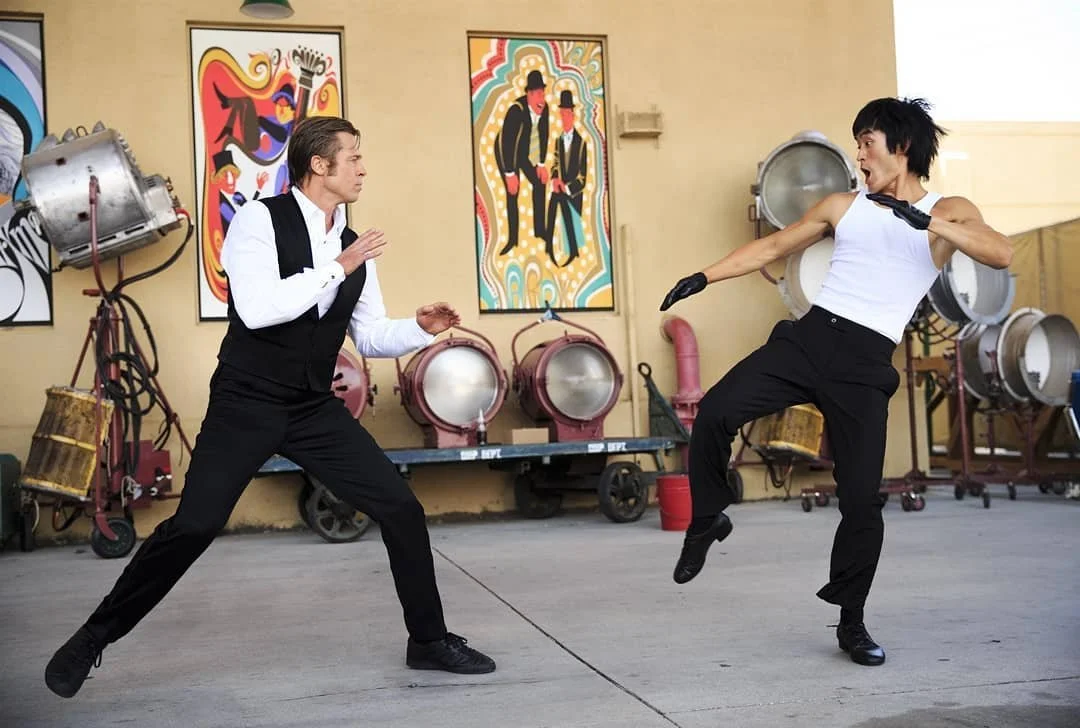
Moles in the background of “Once Upon a Time in Hollywood”.
THE CHANGING INDUSTRY
By the latter part of the twentieth century, Mole-Richardson was no longer the only name worth considering when purchasing professional lighting equipment. ARRI had become a formidable competitor, producing excellent tungsten and HMI fixtures of its own, while companies like Kino Flo were introducing entirely different approaches to lighting. Fluorescent fixtures made it possible to produce broad, soft illumination without the enormous heat associated with traditional tungsten instruments, and HMI technology allowed cinematographers to generate powerful daylight-balanced light without sacrificing nearly as much output to correction gels. Still, Mole-Richardson remained a respected manufacturer, and its tungsten fixtures continued to be used throughout the industry. The real challenge came with the development of high-output LED lighting, a technology that fundamentally changed what filmmakers expected from their equipment.
Now I'll be the first to admit that early LED fixtures weren't particularly impressive. I remember using lights that had questionable color reproduction, strange green or magenta shifts, and output that wasn't remotely comparable to a traditional tungsten fixture of similar size. They were convenient, certainly, but convenience only goes so far when you're trying to produce beautiful images. Over time, however, the technology improved tremendously. Litepanels helped establish LEDs in professional production, ARRI introduced its L-Series Fresnels and eventually the SkyPanel, and newer manufacturers like Aputure began producing increasingly capable fixtures at prices that would have seemed almost absurd a decade earlier. Suddenly you could purchase a powerful, color-accurate LED fixture for a fraction of what a comparable professional light might once have cost. Better yet, it consumed considerably less electricity, generated less heat, and offered features that tungsten fixtures simply couldn't match.
To Mole-Richardson's credit, the company did attempt to adapt. Its later catalogs included an extensive lineup of LED fixtures, including the Vari-Baby, Vari-Junior, Vari-Senior, Vari-Tener, and even enormous instruments like the Vari-Big Eye. The company wasn't simply sitting around waiting for tungsten lighting to become fashionable again. It was developing new products and attempting to compete in a rapidly changing market. The problem, at least as I see it, was that the market itself had changed. For decades, Mole-Richardson had built equipment primarily for studios, rental houses, and professional crews who valued durability and serviceability above almost everything else. The new LED market was considerably broader. Independent filmmakers, small production companies, content creators, and even hobbyists were purchasing lighting equipment, and many of them weren't particularly interested in paying a premium for something that might last fifty years. They wanted lightweight fixtures, battery power, wireless control, adjustable color temperature, and increasingly sophisticated color features. And they wanted all of it at a reasonable price.

A Mole as the Batman light in Christopher Nolan’s series.
I don't think it's fair to say that LED lighting alone killed Mole-Richardson. Manufacturing costs, international competition, changes in Hollywood production, and the general decline of certain types of domestic industrial manufacturing all likely contributed. Without access to the company's financial records, it's difficult to say precisely what went wrong. Still, I think it's reasonable to suggest that the industry had moved away from the qualities that once made Mole-Richardson the obvious choice. The company's reputation was built on producing substantial, beautifully engineered lighting instruments that could endure decades of professional use. But when a competing fixture weighs half as much, consumes a fraction of the electricity, and costs considerably less, it's difficult to convince a modern buyer that they should spend more simply because the housing is built like a tank. The irony, of course, is that many of those old Moles are still working today, while some of the early LED fixtures that replaced them have already become electronic waste.
In December 2025, Mole-Richardson's remaining inventory and equipment went to auction at its facility in Sylmar, California. More than 800 lots were advertised, including Fresnels, LED fixtures, power distribution equipment, stands, spare parts, and some of the enormous specialty instruments that had made the company famous. After nearly a century of manufacturing lights for Hollywood, the company was closing its doors. I can't imagine what that must have felt like for the people who had spent their careers working there. Generations of engineers, machinists, electricians, and technicians had helped develop and manufacture equipment that illuminated some of the most recognizable images in motion picture history. Now the factory was being emptied, and the tools that had once represented the future of filmmaking were being sold off to the highest bidder. There's something profoundly sad about that, particularly when you consider just how much of Hollywood's history was tied to those distinctive maroon fixtures.
Still, I suppose the question worth asking is whether we actually need tungsten lighting anymore. After all, if LEDs are cooler, more efficient, more flexible, and often safer, why should anyone bother keeping the old fixtures around? It's a fair question, and one that I've been thinking about quite a bit lately.

THE CASE FOR HARD LIGHT
I'll admit that for years, I considered tungsten lighting to be something of an inconvenience. Why would I want to deal with a 2K Fresnel when I could produce a similar amount of light with an LED that consumed a fraction of the power? Why would I want to carry around rolls of gels, boxes of scrims, and heavy dimmers when I could simply adjust the color temperature and intensity from a control panel? And why would I want to stand next to a light that was hot enough to burn me when a modern fixture could accomplish the same thing without turning the room into an oven? The answer, at least from a practical standpoint, is that I probably wouldn't. I still use LEDs for the vast majority of my work, and I have no intention of abandoning them. But I've come to realize that there's a difference between making filmmaking more convenient and making the images themselves better. And while LED technology has certainly accomplished the former, I'm not entirely convinced it's always accomplished the latter.
One of the things I've noticed about contemporary cinematography is just how much of it relies on soft lighting. Now don't misunderstand me, I love a good soft source. I've used enormous diffusion frames, book lights, bounced fixtures, softboxes, and just about every other method of producing soft illumination that you can imagine. There's a reason these techniques are so popular. Soft light is flattering, relatively forgiving, and often produces a beautiful, natural-looking image. It's particularly useful for interviews, which make up a considerable portion of the work we do at Spirit Juice. But somewhere along the way, I think we've begun treating soft lighting as though it's automatically better lighting. Watch enough cinematography tutorials and you'll see the same basic approach repeated over and over again: put a large soft source close to your subject, add a little negative fill, perhaps throw a practical lamp in the background, and call it a day. Does it work? Absolutely. Does it look good? Often. Is it particularly interesting? Well, that's where I start to have some questions.
I think we're living through something of a boring era in cinematography. Not necessarily because filmmakers lack talent, or because modern cameras and lenses aren't capable of producing extraordinary images. Quite the opposite, actually. The tools available to filmmakers today are astonishing, and the technical quality of even relatively inexpensive equipment would have been unimaginable twenty years ago. But I think that accessibility has also created a certain sameness in the images we produce. Everything is beautifully exposed, perfectly color balanced, and wonderfully clean. Faces are softly illuminated, shadows are carefully controlled, and backgrounds are filled with tasteful little pools of light. It's all very pretty. Yet I find myself watching older films and being reminded that cinematography can be so much more than simply making a scene look pleasant. Light can be dramatic. It can be mysterious. It can be uncomfortable. It can create shapes and textures that become as important to the composition as the actors themselves. And sometimes, a hard light is precisely what you need to accomplish that.

Think about the cinematography of Citizen Kane, Double Indemnity, or The Third Man. These films are filled with dramatic shafts of light, deep shadows, silhouettes, and striking compositions that would look entirely different if everything had been illuminated through an enormous softbox. Of course, I'm not suggesting that every film should look like a 1940s noir. That would get rather tiresome as well. But those cinematographers understood something that I think we sometimes overlook today: darkness is every bit as important as light. A well-placed hard source can create an extraordinary amount of drama with relatively little equipment. A single Fresnel shining through a window can cast beautiful shadows across a room. Add a little atmosphere, and suddenly that beam of light becomes visible in the air itself. Position a flag or a cucoloris in front of the fixture, and you can create patterns of light and shadow that give an otherwise ordinary scene a tremendous amount of character. You aren't simply illuminating the subject. You're shaping the entire image.
Now it's worth explaining that a Fresnel isn't inherently limited to producing hard light. Like any source, its apparent size relative to the subject determines much of the quality of the illumination. Put a Fresnel through a large diffusion frame and you can create a wonderfully soft source. Bounce it into a white wall and you'll get something entirely different. But what I particularly love about Fresnels is the control they offer when used directly. You can spot the beam down, flood it out, trim the edges with barn doors, reduce intensity with scrims, and shape it with flags and cutters. It's a wonderfully versatile system, and one that encourages you to think about the light itself rather than simply choosing a setting from a menu. Want to reduce the intensity without changing the color temperature? Drop in a scrim. Want to keep the light off a particular part of the set? Bring in a flag. Want to create the appearance of sunlight filtering through leaves? Use a cucoloris. None of these techniques are particularly complicated, but they require an understanding of how light behaves, and perhaps more importantly, they encourage experimentation.
I think that's one of the things I miss most about the older approach to filmmaking. When your tools are relatively simple, you're forced to become more creative with how you use them. A tungsten Fresnel doesn't have a built-in lighting effect that simulates firelight, police lights, or a flickering television. It doesn't have a color wheel, and it certainly doesn't connect to your phone. If you want to create a particular effect, you need to figure out how to do it. Sometimes that means adding gels, sometimes it means moving the fixture, and sometimes it means constructing an entirely new setup using whatever grip equipment you have available. Is that less convenient than pressing a button? Absolutely. But I would argue that there's something valuable about the process itself. You learn why certain techniques work, you discover new ways of shaping light, and occasionally you stumble upon something beautiful that you never would have considered otherwise.
Interestingly enough, I think some filmmakers are beginning to rediscover this. There's a growing appreciation for stronger contrast, directional lighting, practical sources, and images that aren't afraid to let parts of the frame fall into darkness. Of course, you don't need a vintage Mole-Richardson fixture to accomplish any of this. Modern LED Fresnels can produce excellent results, and in many situations they're the more sensible choice. But there's something about working with the original instruments that I find particularly appealing. Perhaps it's the mechanical simplicity, perhaps it's the beautiful quality of tungsten light, or perhaps it's simply the knowledge that I'm using the same basic technology that generations of cinematographers relied upon before me. Whatever the reason, I've found myself increasingly interested in exploring what these old lights can do, rather than simply admiring how they look sitting in the corner of a studio.

COLLECTING THE MOLES
One of the more interesting consequences of the industry's transition to LED lighting is that vintage tungsten fixtures have become remarkably affordable. Now I don't mean that every Mole-Richardson light is cheap, particularly if you're looking for some of the rarer or more unusual models, but compared to their original selling prices, many can be purchased for next to nothing. A beautiful old 1K Fresnel might sell for less than a decent modern light stand, and even some of the larger fixtures can be found for surprisingly reasonable prices. Of course, there's a reason for that. They're heavy, they consume tremendous amounts of electricity, and shipping one across the country can sometimes cost more than the fixture itself. And if you're buying something particularly large, you'd better have a plan for powering it. A cheap 10K isn't much of a bargain if you don't have the electrical infrastructure to turn it on. Still, for someone who appreciates old equipment and has the ability to put it to use, the current market presents some rather extraordinary opportunities.
I've recently begun building a small collection of my own, and I'll admit that it's become something of an obsession. I find myself searching through eBay listings, studying old catalogs, and comparing the differences between models that, at first glance, appear nearly identical. Some of the older fixtures are particularly beautiful, with brass hardware, substantial castings, and wonderfully simple mechanical controls. Others are more modern, but still retain that unmistakable Mole-Richardson appearance. The maroon finish is perhaps the most recognizable feature, although I have a particular appreciation for some of the older two-tone fixtures as well. There's something about the combination of painted metal, brass, and thick glass that I find almost irresistible. They look like serious equipment, because they are serious equipment. And unlike so many vintage objects that have become little more than decorative curiosities, these lights can still do precisely what they were designed to do.
Now before anyone rushes off to purchase a fifty-year-old tungsten fixture, I should probably offer a word of caution. These are not household lamps, and they shouldn't be treated as such. Many older examples have deteriorated wiring, questionable connectors, damaged insulation, or missing grounding connections. Some use theatrical connectors that aren't compatible with ordinary household outlets, and others require lamps that are becoming increasingly difficult to source. If you're planning to use one, have it inspected and serviced by someone who understands the equipment. The fact that a fixture turns on doesn't necessarily mean it's safe. And remember, these things get hot. Very hot. They require appropriate stands, proper clearances, and an understanding of their electrical requirements. I don't want anyone reading this article to assume that because I enjoy collecting old Moles, I'm suggesting that you should plug one into the nearest outlet and hope for the best. There's a reason professional electricians and grips spent decades learning how to work with these instruments.
With that said, I think there's something rather wonderful about the idea of keeping a few of these fixtures in working condition. I'm not interested in collecting them simply to display on a shelf, although I certainly appreciate their appearance. I want to use them. I want to experiment with different lighting techniques, learn more about the fixtures themselves, and perhaps rediscover some of the skills that have become less common in the modern production environment. And I think there's something especially appealing about doing so with equipment that might be older than I am. These lights have already survived decades of technological change, and with proper care, there's no reason some of them couldn't continue working for decades to come. I can't say the same about many of the electronic devices I purchase today.
THE DISAPPEARING CRAFT
The more I've thought about Mole-Richardson's closure, the more I've realized that my disappointment has relatively little to do with tungsten lighting itself. I don't believe the industry should abandon LEDs and return to the enormous, power-hungry fixtures of the past. That would be ridiculous, particularly for someone like me who spends so much time filming in historical buildings and locations with limited electrical infrastructure. Modern lighting technology has made my job easier, safer, and in many cases considerably more creative. I can accomplish things today with a small crew that would have required substantially more equipment and personnel twenty years ago. I appreciate that tremendously. But I do worry about what happens when we gradually lose the tangible elements of filmmaking, particularly the tools and processes that once forced us to develop a deeper understanding of the craft.
Think about how much of filmmaking has become computerized. Our cameras are computers. Our editing systems are computers. Our color grading is performed on computers. Our lenses communicate electronically with our cameras, which can automatically correct distortion, compensate for breathing, and perform all sorts of calculations that once required considerable mechanical or optical engineering. Even our lighting fixtures are essentially computers with LEDs attached. I can walk onto a set, pull out my phone, and adjust the brightness, color temperature, tint, and hue of multiple fixtures without touching a single one. I can save presets, create elaborate lighting effects, and synchronize everything wirelessly. It's absolutely remarkable technology, and I use it all the time. But sometimes I find myself wondering whether we're gradually becoming computer operators rather than filmmakers.

Now that's probably a bit dramatic, and I don't mean to suggest that modern cinematographers lack skill. Quite the opposite. Some of the most talented filmmakers working today are producing extraordinary images using tools that would have been unimaginable to previous generations. But I do think there's a difference between understanding how to create an effect and knowing which button activates it. There's a difference between knowing how light behaves and knowing which settings produce a pleasing image. And there's certainly a difference between mastering a tool and becoming dependent on its conveniences. When I was learning to light, understanding electricity wasn't optional. You needed to know how many amps a fixture drew, how to distribute power safely, and what happened when you overloaded a circuit. You needed to understand the relationship between light intensity and color temperature, how to use gels and scrims, and how to shape a beam using flags and cutters. You learned these things because the equipment demanded it. Today, many of those challenges have been reduced to settings on a screen.
I think the danger is that as we eliminate the inconveniences of filmmaking, we may also eliminate some of the experiences that made us better at it. There's a certain amount of education hidden inside the struggle. When you spend half an hour moving a light, adjusting a flag, changing diffusion, and experimenting with different angles, you're learning something about the behavior of light that you might never fully appreciate if you simply dial in a preset. When you have to calculate power requirements and figure out how to illuminate a scene with a limited number of fixtures, you're forced to think creatively about the tools available to you. And when you make mistakes, as we all inevitably do, those mistakes become part of your education. I can't tell you how many times I've learned something valuable because a particular setup didn't work the way I expected. Sometimes the frustration itself leads to a better idea, and sometimes you discover a technique that becomes part of your approach for years to come.
Of course, I don't think difficulty automatically makes something better. There's no artistic virtue in burning your fingers on a hot lamp or spending an hour running power cables when a battery-powered LED would accomplish the same thing in five minutes. But I do think there's value in understanding the processes that modern technology has made unnecessary. A photographer who understands manual exposure will generally have a better grasp of what their camera is doing, even when shooting in an automatic mode. A cinematographer who understands how to shape hard light will be better equipped to use a modern LED fixture creatively, even if they never touch a tungsten lamp again. And a filmmaker who understands the mechanical and optical principles behind their equipment will have a broader set of tools available when the convenient solution doesn't produce the desired result. Knowledge doesn't become obsolete simply because technology makes it less necessary.
This is one of the reasons I've always been drawn to vintage cameras and lenses. I love the way they look, certainly, and I appreciate the craftsmanship that went into their construction. But more than that, I enjoy the experience of using them. There's something about operating a fully mechanical camera that makes you think differently about photography. You slow down, you pay attention, and you become more deliberate in your decisions. I don't necessarily produce better photographs with an old Nikon F3 than I do with a modern digital camera, but I do find that the process itself changes the way I approach the image. And sometimes, that change is precisely what I need. I think the same can be said for lighting. Working with an old Mole-Richardson Fresnel isn't necessarily going to produce a better image than a modern LED, but it may encourage me to approach the scene differently. And that, in my opinion, is reason enough to keep one around.

ONE LAST LOOK INTO THE LIGHT
I suppose there's a certain irony in the fact that I've developed such an appreciation for Mole-Richardson only after the company has disappeared. For years, I treated its fixtures as interesting relics of Hollywood history, beautiful pieces of equipment that looked wonderful in the background of an interview but weren't particularly necessary for the work I was doing. Now I find myself searching for them, reading about their history, and trying to preserve a few examples before they become increasingly difficult to find. Perhaps that's what happens when something we've taken for granted suddenly becomes finite. As long as Mole-Richardson was still manufacturing lights, the old fixtures were simply old fixtures. Now they're artifacts of a nearly century-long chapter in American filmmaking, and there won't be any more rolling off the production line.
What makes that particularly sad to me is the realization that we're losing more than a manufacturer. We're losing another tangible connection to the history of our craft. Mole-Richardson was there during the transition from silent pictures to sound films. Its fixtures helped illuminate the golden age of Hollywood, the rise of television, the development of modern color cinematography, and countless productions that have shaped the way we understand visual storytelling. For nearly a hundred years, those distinctive maroon lights stood behind the cameras while the world watched what happened in front of them. They were handled by generations of electricians, grips, and cinematographers, many of whom learned their craft using the very same instruments. And because they were built so well, some of those lights are still working today. There's something rather remarkable about that.
I don't know what the future holds for the surviving Mole-Richardson fixtures. I suspect many will continue to find their way into studios, collections, and the occasional production that still appreciates the character of tungsten lighting. Others will become decorative lamps, conversation pieces, or eventually scrap metal when their owners decide they're simply too heavy or inconvenient to keep. For now, they're relatively cheap and widely available, but I wonder how long that will remain the case. As the industry continues moving away from tungsten, fewer people will have the equipment or experience necessary to maintain them, and the number of working examples will inevitably diminish. It's difficult to imagine a future in which a young filmmaker walks into a studio and learns to light using a Mole-Richardson Fresnel in the same way I did at Ball State. And I think that's a shame.
Still, I suppose there's something encouraging about the fact that these lights have already outlived the company that built them. Peter Mole and Elmer Richardson set out to solve a problem for Hollywood nearly a century ago, and the instruments that resulted were so well designed that many remain useful today. That's an extraordinary accomplishment, particularly in an industry that seems increasingly obsessed with replacing equipment every few years. I can't help but admire the engineers and machinists who built these things, and I hope that by keeping a few of them in working condition, I can preserve at least a small piece of that history. Not simply as a collector, but as a filmmaker who still has something to learn from the tools of those who came before him.
I think back to those early days at Ball State, standing in a studio surrounded by enormous maroon fixtures, pulling on a pair of gloves before adjusting a light. At the time, I didn't know much about Peter Mole, the history of the Fresnel Solar Spot, or the generations of filmmakers who had relied on those instruments. I just knew they were hot, heavy, and capable of producing some beautiful images. Nearly two decades later, I know a little more about the company, and I have a considerably greater appreciation for the craftsmanship that went into its products. But perhaps more importantly, I've come to appreciate the lessons those old lights still have to teach us. They remind us that filmmaking is a physical craft, that beautiful images often require experimentation, and that the tools we use can shape the way we think about our work.
I don't intend to give up my LEDs. I rather like being able to light a scene without turning the room into an oven, and I certainly don't miss hunting for electrical panels in old churches. But I do intend to keep a few Moles around, and I intend to use them. Not because they're necessarily better than the alternatives, but because they offer something different. They make me think, they make me experiment, and they connect me to a tradition of filmmaking that I hope we never entirely lose.
For nearly a century, Mole-Richardson built lights that helped illuminate some of the greatest stories ever told. The company may be gone, but its instruments remain, and I suspect they still have a few stories left to illuminate.
And perhaps, if we're willing to put on a pair of gloves and turn them on, they might teach us a thing or two along the way.